
Reimbursement for Business Use of Personal Vehicles
Study prepared for The Treasury Board of Canada Secretariat
By Corporate Fleet Services
1. Fuel Price Update Synopsis
Corporate Fleet Services (CFS) has been mandated by the Treasury Board of Canada Secretariat to perform the annual evaluation of per-kilometre Reimbursement Rates for government employees who are required to use their personal vehicles while performing government business. Furthermore, the periodic impact of varying fuel prices is to be evaluated quarterly by producing three additional Fuel Price Updates per year. The present document represents the Update for May 2026 (for publication on July 1st, 2026).
The latest annual study established Reimbursement Rates for each Canadian Province and Territory after performing a comprehensive analysis of all vehicle operating expenses. These rates were presented in the Reimbursement for Business Use of Personal Vehicles Report, dated November 2025 (for publication on January 1st, 2026). A subsequent Fuel Update was produced for February 2026 (for publication on April 1st, 2026).
The present Update reflects the impact of current fuel prices on the Travel and Commuting Rates’ recommendations made in the Annual Report, with a focus on average pump prices of gasoline by Province and Territory. The prices were averaged for each Province or Territory for the three months prior to the release of the current Update (the months of March, April and May 2026). All prices are given in dollars per litre.
This Update also presents the latest recommended rates of reimbursement for consideration by the Treasury Board Secretariat in dollars per kilometre. The recommendations for Reimbursement Rates are given for:
- Travel Rates (travellers authorized and reimbursed to use their personal vehicles on government business travel), also referred to as “Kilometric Rates” in the National Joint Council Travel Directive (Appendix B), and
- Commuting Rates (employees reimbursed their variable expenses to use their personal vehicles to commute to their designated remote worksites), also referred to as “Lower Kilometric Rates” in the National Joint Council Commuting Assistance Directive (Appendix A).
Federal and Provincial sales taxes were also researched to determine if there were any recent changes that could have had an immediate impact on the total costs of vehicle ownership and operation.
For the period March - May 2026, fuel expenses represent 21.7% of the total cost of vehicle operation (reflected in the Travel Rates) or a Canadian weighted average of 13.7 cents per kilometre. The present Update identified significant increases in average gasoline prices across Canada, which had an upward effect on Reimbursement Rates everywhere except Nunavut, where they remained constant. As a result, relative to the previous Fuel Update (February 2026, for publication on April 1st, 2026), the Reimbursement Rates for the ten Provinces varied between increases of 2.5 cents per kilometre in New Brunswick, Nova Scotia, Prince Edward Island and Quebec, to 3.5 cents per kilometre in British Columbia. In the Territories, the rates either stayed constant, as was the case in Nunavut, or increased to a maximum of 4.0 cents per kilometre in the Yukon. For a more detailed explanation of the main factors influencing these variations, see Section 2.2 - Gasoline prices across Canada.
2. Fuel Prices
2.1 Energy Market Context
Compared with the last Fuel Update (February 2026, for publication on April 1st, 2026), gasoline prices across Canada have increased significantly following developments in the global crude oil market. The rapid rise in crude oil prices has been driven by an expanding conflict in the Middle East, which has created geopolitical instability and tightened supply due to significant production and transportation disruptions in the Persian Gulf region.
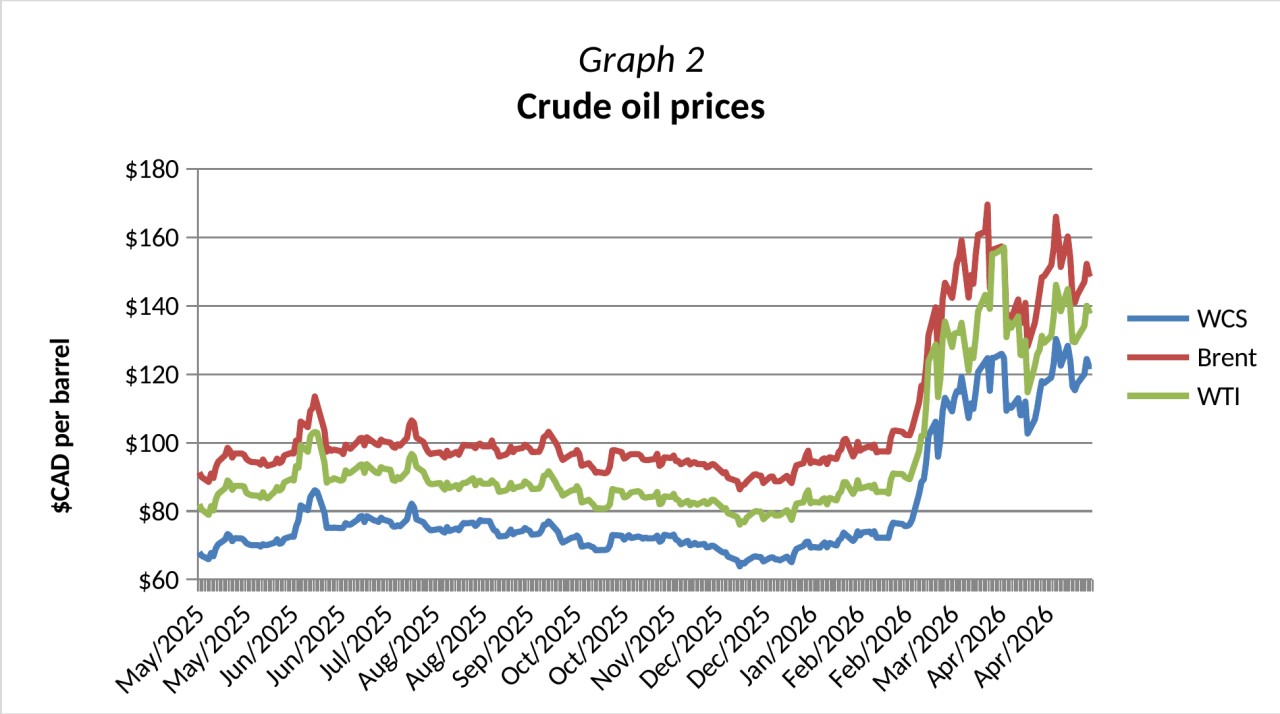
As a result, crude oil prices increased from about $63 USD per barrel for West Texas Intermediate (WTI) and $68 USD per barrel for Brent in February to nearly $113 USD per barrel for WTI and $118 USD per barrel for Brent by late March. News regarding a possible resolution to the conflict has been met with large price swings, resulting in high price volatility. As of May 15th, WTI was trading at $105 USD per barrel and Brent at $109 USD per barrel.
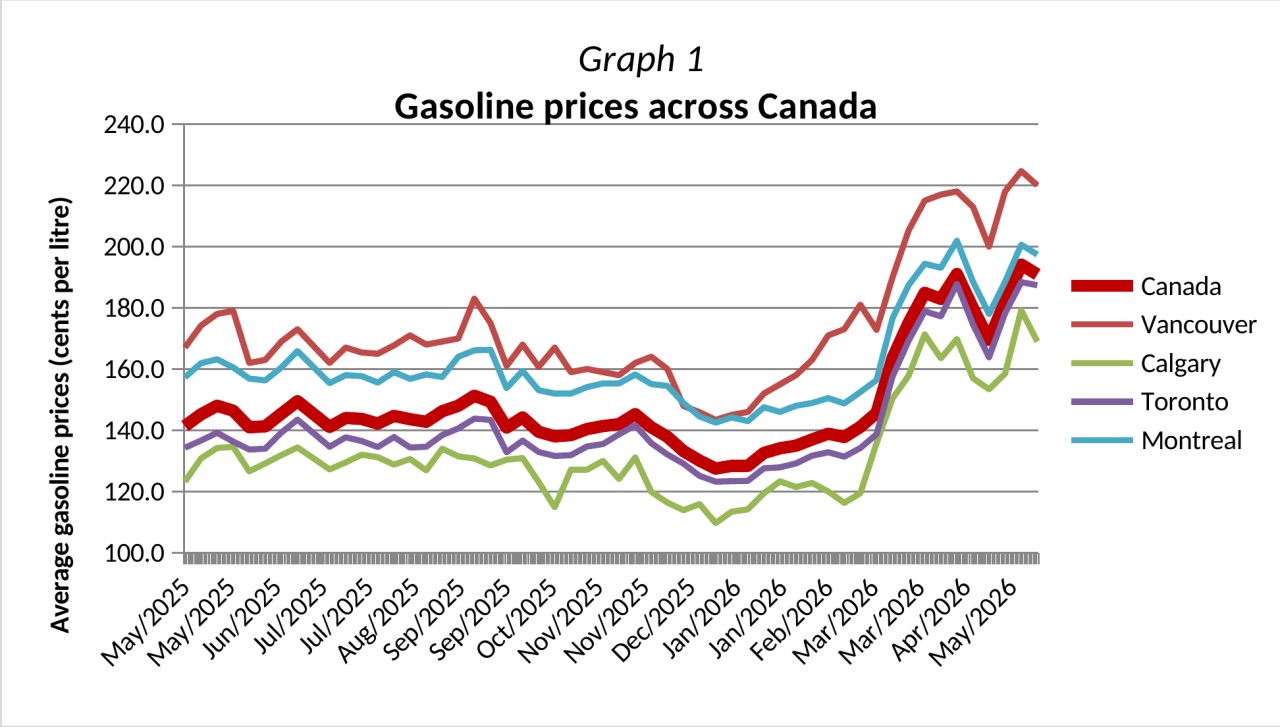
Over the past three months, gasoline prices across Canada increased between 21% and 32%, or between $0.297 and $0.469 per litre, in all provinces and territories except Nunavut, where the average price saw a slight decrease due to the government-set pricing approach (refer to Section 2.2 - Gasoline prices across Canada for details). The daily gasoline price in Canada reached its three-month peak on May 14th, when the national average price was $1.984 per litre. The three-month average gasoline price was $1.735 per litre, compared with $1.355 per litre during the previous three-month period from December 2025 through February 2026, representing an increase of 28.0%. From a year-over-year perspective, the three-month average gasoline price in Canada was 15.4% higher than during the same period last year, when prices averaged $1.504 per litre.
2.1.1 Global Crude Oil Demand
At the beginning of the year, the global economic outlook was on a steady growth path supported by the technology investment boom, some moderation in trade policy tensions, and accommodative financial conditions. However, on February 28th, 2026, the United States (U.S.) and Israel carried out a military mission in Iran, killing some of its political leadership. This led to a war in the Middle East involving many countries in the region and placing significant strain on the global energy industry. As the conflict is still relatively new, all projections regarding its impact on the global economy remain limited and should be considered with caution. Furthermore, downside risks that could lead to less favourable outcomes remain significant and are difficult to quantify. As noted by the International Monetary Fund (IMF), “war, beyond its human toll, imposes extremely high and persistent economic costs and creates acute trade-offs.”
The war in the Persian Gulf has affected crude oil availability, resulting in reduced crude imports in several parts of the world. For example, Chinese seaborne crude imports fell by 3.6 million barrels per day (mb/d) from February to April. Similarly, Japan’s imports declined by 1.9 mb/d, Korea’s by 1.0 mb/d, and India’s by 0.76 mb/d. The petrochemical sector has suffered as raw material availability has become increasingly constrained, pushing refined product prices upward. Another industry that has been severely affected is aviation. Following the disruption of Middle Eastern oil exports, aviation fuel prices nearly tripled, leading to reduced aviation activity. This reduction has eased some pressure on jet fuel prices, although it has had an overall negative effect on the aviation sector.
According to the IMF’s latest World Economic Outlook (WEO) from April 2026, the organization’s “reference forecast” assumes that the conflict will be relatively short in duration and that disruptions will fade by mid-2026, consistent with commodity futures prices as of March 10th. Under this scenario, global economic growth is projected at 3.1% for 2026 and 3.2% for 2027, compared to a 3.4% growth in 2025. This represents a modest downward adjustment of 0.2 percentage points from the forecast issued three months earlier, because the negative effects of the conflict are partially offset by lower tariffs, existing policy support, and stronger-than-expected economic performance at the end of 2025 and during the first quarter of 2026 in some countries. Nevertheless, differences among countries remain significant, with lower-income and commodity-importing economies facing larger economic impacts through higher energy and food prices, as well as foreign exchange depreciation resulting from the appreciation of the U.S. dollar.
The growth outlook for Advanced Economies as a group remains unchanged at 1.8% for 2026 and 1.7% for 2027. The U.S. economy is expected to grow by 2.3% in 2026, representing a 0.1 percentage point decline compared to the projections issued in January 2026. At the same time, Emerging Markets and Developing Economies as a group have seen a downward adjustment of 0.3 percentage points for 2026 and are now projected to grow by 3.9%.
According to the Bank of Canada report from April 2026, Canada’s economic outlook remains largely unchanged, although the composition of Gross Domestic Product (GDP) growth is expected to shift. Because Canada is a net exporter of oil, higher oil prices result in higher income for the industry, while governments receive higher tax and royalty revenues. Nevertheless, consumers and businesses must absorb rapidly rising gasoline and other product costs, reducing purchasing power. Overall, consumption and government spending remain strong, while exports and business investment continue to weaken, extending the pattern observed in 2025. A slowdown in the housing market is also weighing on growth. Similar to the IMF, the Bank of Canada relies on a large number of assumptions, and projections remain highly dependent on future market developments. According to the Bank’s April 2026 Monetary Policy Report (MPR), the baseline scenario projects that the economy will expand by 1.2% in 2026 and 1.6% in 2027. By comparison, the IMF outlook for Canada stands at 1.5% for 2026, representing a reduction of 0.1 percentage points from the IMF World Economic Outlook (WEO) Update issued in January 2026, while the 2027 forecast remains unchanged at 1.9%. In terms of inflation, the Bank of Canada projects that it will rise in the near term (the Consumer Price Index (CPI) stood at 2.4% in March) before easing toward the 2% target in early 2027.
Overall, forecasts regarding global oil demand remain somewhat divergent. On one hand, the International Energy Agency (IEA) projects that demand in the second quarter of 2026 will contract by approximately 2.5%, or 2.45 mb/d, with more than 60% of the decline originating from non-OECD countries. The IEA forecasts that annual global oil demand will decline by 0.42 mb/d in 2026, to average 104.0 mb/d, representing a reduction of 1.3 mb/d from the pre-war forecast. This outlook is generally consistent with the U.S. Energy Information Administration (EIA) forecast, which projects global oil demand at 104.2 mb/d in 2026, representing a modest increase of 0.2 mb/d over 2025 levels. On the other hand, OPEC’s Monthly Oil Market Report (MOMR) from May 2026 projects demand growth of 1.2 mb/d in 2026, bringing average global demand to 106.3 mb/d compared with the estimated 105.2 mb/d in 2025.
2.1.2 Global Crude Oil Supply
Global crude oil markets have shifted from persistent oversupply and downward price pressure at the beginning of the year to rapidly rising prices and heightened volatility following the outbreak of war in the Middle East involving the U.S., Israel, Iran, and several other Persian Gulf countries. On February 28th, 2026, the U.S. and Israel launched joint air strikes on Iran, killing several key Iranian officials, including the Islamic Republic’s longtime supreme leader. Iran responded quickly by targeting key infrastructure across the Persian Gulf, including U.S. military bases and energy production as well as refining facilities.
Within days of the initial strikes, attacks on ships transporting oil in the Gulf led to the closure of navigation through the Strait of Hormuz, affecting oil production and transportation. The Strait of Hormuz is a waterway connecting the Persian Gulf and the Gulf of Oman. It provides the only sea passage from the Persian Gulf, where many oil-producing countries are located, including the United Arab Emirates (UAE), Qatar, Bahrain, Kuwait, and Iraq, to the open ocean. Between 2023 and 2025, 25% of the world’s seaborne oil trade passed through the strait annually. It remains a critical petroleum export route for Europe and Asia and is particularly important for Europe’s energy supply. As of early May, more than 10 weeks after the beginning of the conflict, supply disruptions due to the closure of the Strait of Hormuz persist, while global oil inventories are depleting at a record pace.
Due to the conflict, OPEC production plunged from 28.7 million barrels per day (mb/d) to 20.8 mb/d in March 2026, representing a decline of 27% compared with February 2026 levels. Saudi Arabia, OPEC’s largest producer, reduced production by 23%, from 10.1 mb/d to 7.8 mb/d, following attacks on a critical East-West pipeline transporting oil from the Persian Gulf to the Red Sea. Production in Iraq experienced the largest decline, collapsing by 61% from 4.2 mb/d in February to 1.6 mb/d in March. Similarly, production in Kuwait and the United Arab Emirates declined by 53% and 44% month over month, respectively. At the same time, Iranian production fell by only about 5%, from 3.24 mb/d to 3.06 mb/d in March compared with February. Since Iran largely controls the Strait of Hormuz, it has continued exporting its oil through the strait during the war.
According to IEA estimates, output from Gulf countries affected by the Strait of Hormuz closure was 14.4 mb/d below pre-war levels, while other producing countries ramped up production to help offset the shortfall. In response to the crisis, producers outside the Persian Gulf increased output and exports to record levels. According to the IEA, 2026 supply growth expectations for the Americas have been revised upward by more than 0.6 mb/d since the start of the year, reaching an average increase of 1.5 mb/d. The largest export increases have been observed in the United States, Brazil, Canada, Kazakhstan, and Venezuela.
The U.S. EIA has revised its oil production projections for the United States. While production estimates for 2026 remain unchanged at 13.6 mb/d, equal to 2025 levels, the projection for 2027 has increased significantly from 13.3 mb/d to 14.1 mb/d, forecasting a new production record. This increase is occurring despite a slight decline in rig counts amid tighter capital discipline among independent producers. While Canada has maintained relatively stable production levels, stronger external demand and higher crude prices have increased industry revenues. In addition, Canada has seen renewed investment interest from major international corporations, including Shell, among others.
The United Arab Emirates (UAE) announced its exit from the OPEC and OPEC+ groups effective May 1st, 2026. The UAE had been an OPEC member for nearly 60 years and was the cartel’s third-largest producer. Experts suggest the UAE could increase oil production by approximately 1.0 mb/d outside the OPEC framework. Additionally, in an attempt to ease market tightness, the United States temporarily waived sanctions on Russian oil transported by sea, resulting in increased Russian crude exports.
Before the conflict in the Middle East, global oil reserves stood at 8,210 million barrels in January 2026. On March 11th, IEA member countries agreed to release 400 million barrels of oil from emergency reserves to address disruptions stemming from the war in the Middle East. By early May, 164 million barrels had already been released to the market. The U.S. EIA forecasts that global oil inventories will decline by 2.6 mb/d this year, equivalent to nearly one billion barrels in total.
The IEA assumes that flows through the Strait of Hormuz will gradually resume beginning in June. Nevertheless, global oil supply is projected to decline by an average of 3.9 mb/d in 2026, falling to 102.2 mb/d compared to 106.1 mb/d in 2025. This represents a significant downward revision of 6.4 mb/d compared to the February 2026 projection of 108.6 mb/d. The IEA projects that demand could exceed supply by 1.8 mb/d in 2026. The U.S. EIA’s global production estimates are generally consistent with the IEA outlook, projecting production at 101.6 mb/d, representing a decline of 4.8 mb/d compared with 2025 and a downward adjustment of 6.3 mb/d relative to pre-war projections. Under this scenario, global demand would exceed supply by 2.6 mb/d in 2026.
The war has triggered a major market shock and increased oil price volatility, with crude benchmarks experiencing wide price swings in response to conflicting signals regarding a possible resolution between the U.S. and Iran. The World Bank notes that “oil-price volatility during periods of rising geopolitical risk is roughly twice as high as during calmer periods, with a geopolitically driven 1% decline in oil production pushing prices up by an average of 11.5%.” For example, the Brent benchmark dropped from $118 USD per barrel on March 31st to $101 USD per barrel on April 1st, representing a decline of approximately 14.5% in a single day. WTI experienced a similar decline, falling from $113 USD per barrel to $94 USD per barrel between April 7th and April 8th, representing a drop of nearly 17% in one day. Such price swings have become increasingly common in recent months following news related to possible resolutions to the conflict in the Middle East, which have yet to materialize.
2.2 Gasoline Prices Across Canada
Over the past three months, average gasoline prices in Canada have risen rapidly in line with global crude oil benchmarks. The increases have been relatively consistent across all Canadian provinces. In Eastern Canada, average gasoline prices increased by 22.2% in Quebec and 22.5% in New Brunswick, while Nova Scotia experienced an increase of 26.3%. Prices in the Prairies and Western Canada increased between 30.8% in British Columbia and 32.3% in Manitoba. Ontario, with a 29.1% increase, fell near the middle of the range. The Northwest Territories experienced an increase of 21.6%, while the Yukon recorded an increase of 23.5% as compared to the previous Fuel Update (February 2026, for publication on April 1st, 2026). Nunavut was the exception as the three-month average price for gasoline declined by 1.7% (see below for additional details).
Prices of gasoline in Canada include all applicable taxes. Prices vary significantly across Canada, mainly due to the difference in the types and amounts of taxes being charged on fuel in different Provinces and Territories. The present Update calculated the average prices of regular gasoline charged at the pump. The fuel price data was primarily obtained from Natural Resources Canada via Kalibrate (previously Kent Marketing), based on daily published fuel prices for 78 locations across Canada. This data was verified against additional databases that similarly track fuel prices all across Canada.
Consistent with the methodology of the Annual Report, when determining average gasoline prices per Province or Territory, we have used weighted averages according to population in order to better conform to reality. In this manner, metropolitan population centers account for a greater portion of the total average price compared to smaller towns.
The following is a table with average regular gasoline prices for all Canadian Provinces and Territories, in dollars per litre, for the period March - May 2026:
|
Province/Territory |
Current fuel price |
April 1st, 2026, Fuel Update Report fuel price |
Price difference |
|---|---|---|---|
|
Alberta |
$1.563 |
$1.191 |
$0.372 |
|
British Columbia |
$1.991 |
$1.522 |
$0.469 |
|
Manitoba |
$1.612 |
$1.218 |
$0.394 |
|
New Brunswick |
$1.685 |
$1.375 |
$0.310 |
|
Newfoundland and Labrador |
$1.823 |
$1.451 |
$0.372 |
|
Northwest Territories |
$1.675 |
$1.378 |
$0.297 |
|
Nova Scotia |
$1.706 |
$1.351 |
$0.355 |
|
Nunavut |
$1.516 |
$1.542 |
-$0.026 |
|
Ontario |
$1.666 |
$1.290 |
$0.376 |
|
Prince Edward Island |
$1.798 |
$1.437 |
$0.361 |
|
Quebec |
$1.800 |
$1.473 |
$0.327 |
|
Saskatchewan |
$1.618 |
$1.227 |
$0.391 |
|
Yukon |
$1.845 |
$1.494 |
$0.351 |
Fuel price data was extracted for a period of three months (February 17th to May 15th, 2026) in order to reflect current gasoline price trends. Subsequent reports will focus on three-month periods following the period covered in the present study. Average gasoline prices per litre and per Province or Territory were found to vary between $1.516 in Nunavut and $1.991 in British Columbia, with a Canadian average of $1.735 per litre, a significant increase of 38.0 cents from the previous Fuel Update (February 2026, for publication on April 1st, 2026).
As described in the sections above, average fuel prices increased significantly across Canada, driven primarily by the sharp increase in global oil prices caused by the conflict in the Middle East. To provide some relief to consumers, the Federal Government temporarily removed the Federal Excise tax from April 20th, 2026, through September 7th, 2026. This measure brought the gasoline price down by 10 cents per litre across Canada, moderately tempering the rapid rise in fuel prices.
The exception to the overall fuel price increase was the average gasoline price in Nunavut, which actually decreased slightly as compared to the previous Fuel Update (February 2026, for publication on April 1st, 2026). This was due to the same cut in the Federal Excise Tax, which brought pre-established gasoline prices across Nunavut down by 10 cents per litre on April 20th, with the exception of Iqaluit, where retail prices followed the same upward trend as the rest of Canada.
For illustration purposes, Graph 1 displays gasoline prices for the main metropolitan areas for a one-year period (May 2025 - May 2026).
Also for illustration purposes, Graph 2 displays crude oil prices for three benchmarks – WTI (West Texas Intermediate), Brent and WCS (Western Canadian Select) for a one-year period (May 2025 - May 2026).
2.3 Sales Taxes
For the current Update, research was performed to see if there were any relevant changes to Federal and Provincial sales taxes that could have an immediate impact on the Reimbursement Rates. As of the date of this Update, no changes were observed in sales taxes anywhere in Canada as compared to the previous Annual Report.
3. Impact of Fuel Prices on Reimbursement Rates
3.1 Fuel Consumption
In calculating the fuel costs contribution to the total vehicle operating costs, the methodology employed in the Annual Report was strictly adhered to. Fuel consumption for every vehicle model in the study was thus combined with average prices per Province or Territory to determine the fuel portion of operating costs, based on an average of 20,000 kilometres per year.
3.2 Updated Reimbursement Rates
For comparison, the following table provides updated Travel (Kilometric) and Commuting (Lower Kilometric) Rates, as well as rates previously calculated for the Annual Report (November 2025, for publication on January 1st, 2026) and the February 2026 Fuel Update (for publication on April 1st, 2026):
Current Reimbursement Schedule (in dollars per kilometre)
|
Travel Rate |
Commuting Rate |
|||||
|---|---|---|---|---|---|---|
|
Province/Territory |
Current Fuel Update |
April 1st, 2026, Fuel Update |
January 1st, 2026, Annual Report |
Current Fuel Update |
April 1st, 2026, Fuel Update |
January 1st, 2026, Annual Report |
|
Alberta |
$0.590 |
$0.560 |
$0.565 |
$0.240 |
$0.210 |
$0.220 |
|
British Columbia |
$0.630 |
$0.595 |
$0.600 |
$0.290 |
$0.255 |
$0.260 |
|
Manitoba |
$0.585 |
$0.555 |
$0.565 |
$0.250 |
$0.220 |
$0.230 |
|
New Brunswick |
$0.630 |
$0.605 |
$0.610 |
$0.260 |
$0.235 |
$0.240 |
|
Newfoundland and Labrador |
$0.645 |
$0.615 |
$0.620 |
$0.270 |
$0.240 |
$0.250 |
|
Northwest Territories |
$0.725 |
$0.695 |
$0.700 |
$0.330 |
$0.295 |
$0.305 |
|
Nova Scotia |
$0.630 |
$0.600 |
$0.610 |
$0.260 |
$0.235 |
$0.240 |
|
Nunavut |
$0.700 |
$0.700 |
$0.705 |
$0.315 |
$0.315 |
$0.320 |
|
Ontario |
$0.655 |
$0.625 |
$0.630 |
$0.255 |
$0.225 |
$0.230 |
|
Prince Edward Island |
$0.620 |
$0.595 |
$0.600 |
$0.270 |
$0.240 |
$0.245 |
|
Quebec |
$0.645 |
$0.615 |
$0.625 |
$0.280 |
$0.255 |
$0.260 |
|
Saskatchewan |
$0.580 |
$0.550 |
$0.560 |
$0.250 |
$0.220 |
$0.230 |
|
Yukon |
$0.730 |
$0.690 |
$0.700 |
$0.350 |
$0.310 |
$0.320 |
Note: All figures were rounded up to the nearest half-cent.
The impact of gasoline prices on the Reimbursement Rates was significant for the present Fuel Update. In comparison to the last Fuel Update (February 2026, for publication on April 1st, 2026), the Reimbursement Rates have increased between 2.5 cents per kilometre and 3.5 cents per kilometre for the Provinces. For the Territories, the Reimbursement Rates have varied between no change to an increase of 4.0 cents per kilometre.
Overall, Canadian weighted averages increased by 3.0 cents per kilometre for both the Travel Rate and the Commuting Rate, compared to the last Fuel Update (February 2026, for publication on April 1st, 2026). They are now at 63.5 cents per kilometre and 26.5 cents per kilometre, respectively.
Fuel contributes on average 13.7 cents per kilometre to total operating costs, ranging from 12.4 cents in Alberta to 20.5 cents in the Yukon. Given the complexity of socio-economic factors affecting the global energy market, it is difficult to make any prediction regarding gasoline prices for the next three-month period. However, any future changes will be reflected in the next Fuel Update.